
Will AI Replace Visual Merchandisers? What the Tools Can Do, and What They Can't
It is a question everyone in every industry is asking, and visual merchandising is no different: is AI going to do my job?
Here is the honest answer, from someone who has spent sixteen years in stores and is an enthusiast and daily user of AI. No.
AI is not replacing the visual merchandiser. It is reshaping the job. And the reason it cannot replace you is simpler than the panic suggests: AI is not creative, it is a creativity partner. It follows the creativity you give it. And AI will not fetch the ladders and build the display. Maybe that will change, maybe not, so let's look at both sides honestly: what AI can do (now and in the near future) and what it can't.
What AI can already do for a visual merchandiser
A lot, and most of it for free. Used well, AI removes the slow, repetitive parts of the work and gives you back time for the decisions that actually matter.
Concepting and ideas. ChatGPT, Gemini and Claude turn a rough brief and your insights into directions, copy and structure in seconds. It might not be perfect, but it gives you a very effective process to reach a good result.
Store and window mockups. Gemini (with Nano Banana) and Microsoft Copilot take a prompt, or a photo of your real space, or your drawing in CAD or SketchUp, and return a visual of the idea. Nano Banana is especially good at editing a real store photo while keeping the scale intact, so you can show a client the change before you build it, safely.
Mood boards and presentations. Canva assembles your images into a board or a client deck, free.
Signage and copy. Canva for the graphic, Claude for the words.
Product shots. remove.bg and Canva handle the clean-up that used to mean a studio.
Shopper behaviour and flow. Google Analytics and Microsoft Clarity show you how people actually move.
Your own sales data. The one most people miss: load your sales spreadsheet into a Claude Project and ask it what is working, which product to pull forward, where the money is. You can even photograph a shelf and ask for a review based on your composition rules.
The administrative work nobody will miss. Planograms, store audits, the twelve-month calendar, checkpoint meeting presentations, reporting. Planograms are the most tedious part of visual merchandising, and I am genuinely glad to hand them to a machine for automation following certain rules and variants.
Notice what all of that is: production and admin. The slow, mechanical layer of the job. Handing it over is a gift, because it gives you back the hours for the part that actually sells. Which is exactly the part AI cannot do.
What AI cannot do, and why that is the whole point
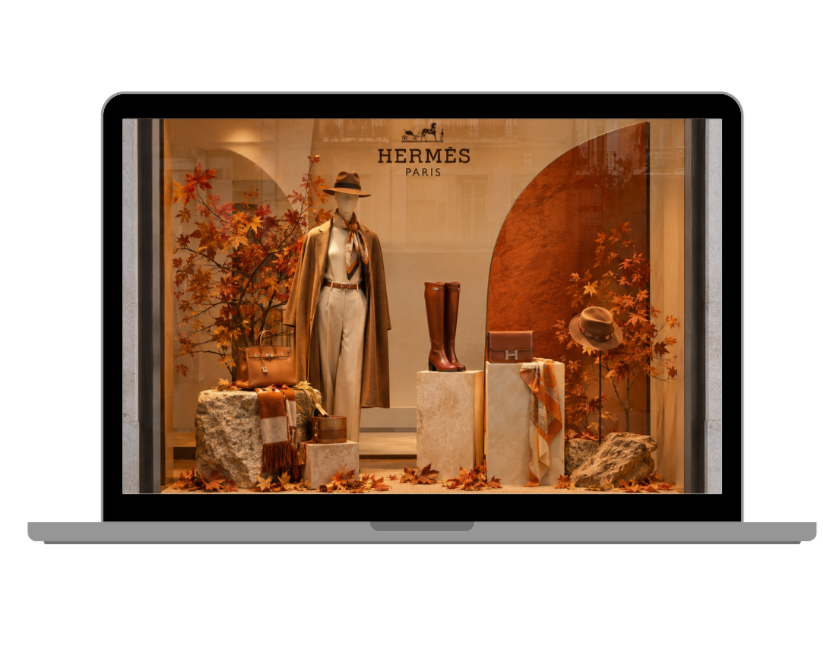
From a prompt or a real photo to a visual of the idea, in minutes. Prompt for creating this image: create a window display hermes inspired in a lisbon street shop window, for a fashion brand and with the autumn theme. make the view from the front
AI will make you a beautiful window projection. Whether it sells is a completely different question, and it is the one AI cannot answer for you. And it will not source materials, or implement on schedule.
Start with the thing everyone assumes AI has, and it doesn't: creativity. AI is not creative. Ask it for a concept and it recombines what already exists. The original direction, the taste, the point of view, still has to come from you, and once you give it, the AI can only follow it. Insights and trends are not numbers on their own, they carry a creative, humanistic base, a way of seeing the information. And in a store, what makes a person feel something is what makes them buy.
That feeling is authored by a human. AI can execute it well once it exists, but it cannot originate it, and it cannot tell you whether the result moves anyone at all.
Then there is everything AI simply has no access to. You have to feed it everything: your commercial goal for the month, what you know about your customer's needs and wishes, your margins, or which product has the stock to be a hero. It makes the picture. It does not make the decision. The creative judgment and the commercial approach at once, that is the discipline of visual merchandising: composition, flow, pricing logic, brand translation and stylistic identity, and the reasons behind every choice.
So the real risk was never that AI replaces you. It is that one person uses AI with that judgment and another uses it without, and the market reads the difference in the sales figures.
What this actually means for your career
It means the ground has shifted in your favour, if you build on both sides.
The visual merchandiser who knows the method and uses the tools is now faster. The brand that leans on AI alone produces empty work. And the one who refuses AI on principle is slowly pricing themselves out of business. The winning position is not "AI or craft." It is craft, amplified by AI.
That is also the order to learn it in. Get the method first, the creative and commercial judgment, because it is what makes everything else worth doing, then let the tools multiply it. A beautiful window is easy now.
A window that sells is still a skill, or an effective layout, and it is still yours to own.
In short
AI is the best assistant a visual merchandiser has ever had, and a terrible replacement for one. It reshapes the craft, it does not replace it. Learn the discipline that tells it what to do, and the tools stop being a threat and start being leverage.
At STEER, that discipline is what we teach: the method behind a display that performs, not just one that photographs well. And for the tools themselves, a dedicated specialization course, AI Tools for Visual Merchandising, is coming before the end of the year.
Leave your email bellow to be one of the firsts notified, at a special launch price.
Frequently asked questions
When should you start planning a Christmas retail display?
Earlier than you think. If you are lucky enough to work for a brand that closes the offer and shares it with the other departments at least six months ahead of production, you should start the creative process and planning around August. Even with small tweaks at the end of September, this gives you October for a month of production and one or two weeks in November for implementation. But the heavy work, the meetings, budgets, approvals and rollout plans, is all done smoothly in September. The most important thing is that the concept and rollout plans are locked before the peak logistics start.
How do you create a seasonal display that fits your brand?
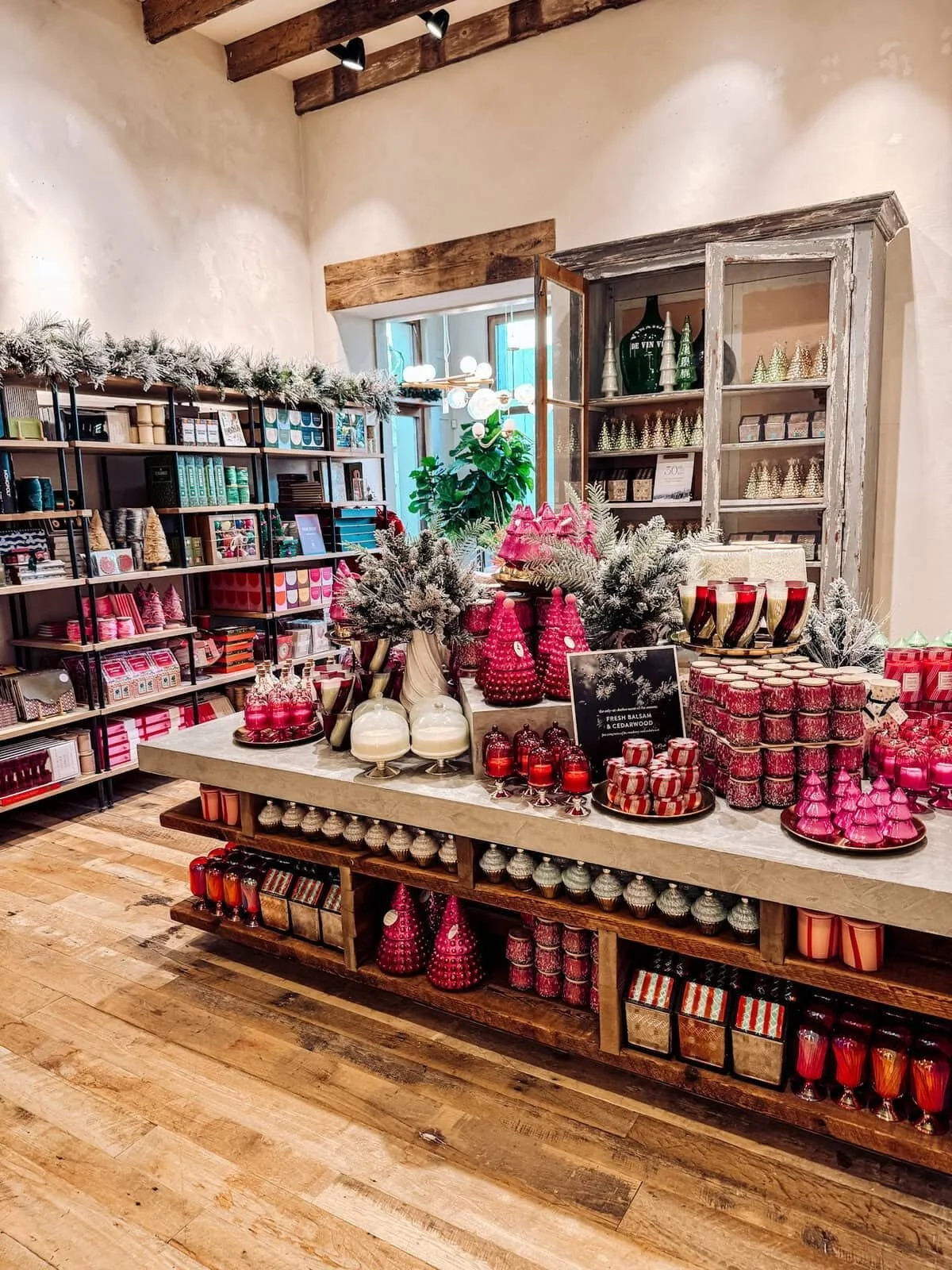
Express the season through the brand's stylistic identity, its own palette, materials and story, instead of applying a generic Christmas template. Every seasonal decision should still communicate the brand's identity and values, so the display reads as this specific brand's atmosphere. Here is a starting point: think of the brand as a person. Is that person feeling cheerful or nostalgic this Christmas? Is it hosting the whole family, or travelling for a new tradition? Is it matching pyjamas or high-end festivities? Phone-free games night, or an Instagrammable photo booth? Don't make it about the decor. Make it about the message people relate to.
