
How to Become a Visual Merchandiser: The Career Guide
Whether you're starting from scratch, switching careers, already working in retail, or building your own independent practice. This guide maps every realistic road into one of the most underestimated creative professions in the industry.
Most people don't plan to become Visual Merchandisers. They discover the profession sideways.
From a design degree that gradually pulled them toward retail. From a sales job where they kept gravitating toward the creative side — rearranging displays after hours, understanding instinctively why certain setups work and others don't. From an architecture career where the spatial experience of a store felt more fun than designing a home. Or from a moment of noticing, somewhere between one job and the next, that the thing they were most naturally good at had a name and a career attached to it.
There's a reason for this pattern. Visual Merchandising is a discipline that lives at the intersection of several worlds simultaneously: design, brand strategy, consumer psychology, and retail sales strategy and operations. It doesn't have a single academic home, because it draws from many. And that, far from being a weakness, means there are multiple valid entry points — which is what this guide is about.
We'll map the backgrounds that give you an advantage, the three main paths people actually take, the honest differences between educational routes, what hiring managers look for, how to build a portfolio before you have the title, and — for those considering an independent route — what building a freelance VM practice actually involves and what it demands from the start.

Photo via Pinterest @Apple
What Visual Merchandising Actually Is, And Isn't
The most persistent misconception about VM is that it's a decorative function: dressing windows, arranging mannequins, following seasonal colour palettes. If that's the definition you're working with, the profession will seem narrow. And the salary, career progression, and strategic weight that serious VM professionals carry won't make sense.
Visual Merchandising is the strategic and creative management of how a brand presents itself in physical space. It encompasses the entire customer experience: the product display logic, the flow of movement through the store, the hierarchy of zones and focal points, the materiality of fixtures, the way a campaign translates from photography into a three-dimensional environment that a person walks through.
At its most fundamental, VM answers one question: does this space make people want to buy and come back?
But the more interesting formulation is further upstream. In higher-level roles, VM is brand language. It's how a brand communicates its identity without words. A luxury brand's VM doesn't just look expensive it creates the feeling of luxury that resonates with the target. A contemporary lifestyle brand's VM doesn't just display products, it sells a version of yourself you want to inhabit. This is not decoration. It is persuasion in three dimensions, and it requires strategic thinking to do at the level the best brands demand.
The best Visual Merchandisers are, in essence, brand translators.
They take what a brand means: its values, its personality, its aspiration, and make it felt in a space.
The scope of the role varies substantially. In an independent boutique, a VM might handle everything: concept, installation, buying alignment, and the photography that ends up on the brand's Instagram. In a global fashion group, the function is highly specialised — separate teams for concept design, window installation, field VM management, and directors who protect brand standards across hundreds of stores in multiple markets. Both ends of that spectrum are valid starting points. The skills travel.
Why Brands Need It More Than Ever
The growth of e-commerce over the past decade forced a real reckoning: what is a physical store actually for? A store that exists only to stock product and process transactions cannot compete with the speed and convenience of online retail. That model is under pressure.
But a store that exists to create an experience — where the brand becomes real, where product can be touched and understood, where the customer feels something no website can replicate — that store is not in retreat. It's in demand. Global brands from ZARA to Apple to major luxury houses have consistently increased investment in their physical environments, because the stores that survive are the ones where stepping inside feels like entering a unique world.
This has moved VM from a support function to a strategic one. For anyone entering the field, the implication is significant: this is not a profession under threat of obsolescence. It's one in transition — toward higher creative and strategic expectations, more sophisticated brand environments, and better-compensated roles for professionals who develop genuine expertise. The independent route, in particular, benefits from this shift — brands that previously wouldn't have engaged an external VM consultant are increasingly open to it, precisely because they understand what good VM is worth.

The Backgrounds That Give You a Head Start
There's no single degree from a college institution that produces a great VM professional. Yet. What there are, however, are backgrounds that sharpen specific skills the role demands and compress the learning curve. Here's an honest read of each.
Design — Graphic, Interior, Industrial, Spatial, etc
Design education gives you a trained understanding of composition, proportion, hierarchy, and how to construct a visual message. You've been taught to look at things critically , to ask not just whether something works, but why.
Graphic designers with direct brand experience deserve a specific mention. They arrive already thinking about visual decisions as communication decisions , which choice of colour, form, or material conveys what, and to whom. In VM, every element in a window or display communicates something about who the brand is and who it's speaking to. A graphic designer who has worked inside brand environments , on campaigns, brand identity systems, seasonal communications , has arguably the most transferable foundation of any design background.
Arts — Fine Arts, Painting, Sculpture
Artists have spent years working with form, light, and spatial composition , understanding how a viewer reads a scene, where the eye rests, what creates tension and what resolves it. A painter understands concept, expression and focal points. A sculptor understands three-dimensional relationships between objects and materials. Beyond the technical skills, a fine arts background tends to produce people genuinely comfortable with ambiguity and capable of original concepts , not variations on a reference, but new ideas. The development area is the commercial context: learning to direct creative instincts in service of a brand's specific objectives, and learning to manage numbers for strategy. This is all learnable. The creative foundation is much harder to build from scratch.
Marketing and Brand Strategy
Marketing backgrounds give you fluency in brand identity and an understanding of business and product. You already think about how a brand communicates across channels, how it differentiates, what it means to its customer. VM is, in large part, the physical channel of that communication. Knowing what a brand is trying to say gives you a significant advantage when translating that message into a store environment. The gap is usually spatial and compositional , design software skills among others , but all buildable through training.
Architecture
Architects have a natural facility for VM that is difficult to overstate. Store layout, spatial proportions, the logic of how people move through space, ergonomics, the relationship between volume and light .these are core architectural competencies that map directly onto VM work, especially store design roles. In many environments, you don't need a VM background to do VM if you're an architect. The spatial literacy is simply already there.
But there's a caveat worth being direct about. Architecture training, at its most rigorous, is fundamentally rational , built around structural logic and the resolution of technical constraints. These are extraordinary strengths. The blind spot that appears regularly is in the brand dimension and a sense of fun: the emotional, sometimes deliberately irrational quality that makes a retail experience feel like a specific brand rather than just a well-resolved room. The creative leap. the willingness to break the rational grid for the sake of impact or identity , is where architects sometimes need to deliberately stretch. The practical recommendation: immerse yourself in brand culture. That conceptual language is the piece to actively develop, and take more creative risks.
The Three Main Paths, And What Each One Actually Looks Like
Beyond formal education, there are three dominant ways people build careers in VM. Understanding them honestly with their real advantages and real trade-offs is more useful than pretending there's one correct route.
PATH 01 | The trained eye enters retail
From a Design or Creative Background
If you've studied design, worked in a creative agency, or spent time in any field that trained your eye and spatial thinking, you'll likely move into VM from a creative direction starting in a junior VM role within a company's VM team, or entering a VM-adjacent position that evolves naturally.
The advantage: you'll earn credibility in the conceptual and creative aspects of the role quickly. You understand visual language. You can generate and communicate ideas. In larger companies, these skills may open doors to VM concept roles, brand visual teams, and eventually VM direction.
The gap to develop: the retail and commercial context. Understanding how store actually operates the logistics of product rotation, the reality of stock levels, the relationship between visual presentation and sales conversion takes time to internalise if you haven't lived it. The designers who grow fastest are those who come to see commercial constraints not as limitations on their creativity, but as the parameters that make creative decisions meaningful.
PATH 02 | Operational intelligence meets creative ambition
From the Sales Floor
This is the path that gets less formal recognition in industry conversations. It also produces some of the most effective VM professionals working today.
People who come from sales associates, supervisors, store managers who develop a strong visual sensibility are everywhere in retail. They're the ones who rearrange the display at the end of a shift because something about it bothers them. Who can sense, before the numbers confirm it, that a product isn't performing because of where it's sitting. Who walk into a competitor's store and immediately understand what they're doing differently and why.
The problem is that in most retail environments, this talent stays invisible unless someone with authority actively creates an opportunity. That does happen but it's rare, and relying on it is not a strategy for a career.
The person who comes from the sales floor with specialised VM training has something genuinely rare:
they understand the store from the inside out. The operational logic, the customer rhythm, the commercial stakes
all already internalised. Add the creative and strategic language of VM, and you have a profile that most hiring managers
will not find easy to walk away from.
When sales floor experience is combined with a proper VM course a programme that genuinely teaches visual principles, brand methodology, store planning, and portfolio development the result is a candidate with a complete profile. This combination is, arguably, more valuable than a design degree alone, because the commercial context doesn't need to be learned on the job. It's already there.
PATH 03 | Your own clients, your own trajectory
Building an Independent Practice
The independent route is less discussed in career guides, and more viable than most people assume. It is also the path that demands the most self-direction from the star, which is precisely why it suits a specific kind of person.
An independent VM starts by taking on small projects: a boutique opening, a pop-up installation, a seasonal refresh for a local retailer, a brand that can't yet afford a full-time VM but understands they need one. These projects are not glamorous. They are, however, extraordinarily useful , because each one is a complete cycle. You develop the concept, manage the execution, deal with the client relationship, and document the result. In an employed role, that full cycle might take years to experience across all its dimensions. As an independent, you experience it from the first project.
The portfolio builds faster, but it requires more deliberate curation. Every project should be documented with professionalism , not just a few photos on Instagram, but a structured case study: the brief, the constraints, the thinking, the execution, the outcome in numbers. This documentation is the independent VM's primary commercial asset, and it needs to be treated as such from the beginning.
There is a specific challenge with small clients that's worth naming directly: they tend to undervalue the service, because they haven't yet experienced what good VM does to their sales and customer perception. Part of working independently at the beginning is educating the market , demonstrating, project by project, that this is a commercial investment with measurable returns, not a styling exercise. It's frustrating at times. It is also a real competitive advantage: the independent who can show a small client a concrete before-and-after , in footfall, in average transaction, in return visits , has a story that no amount of portfolio photography can replace.
The Professional Website: Not Optional. For anyone building an independent VM practice, a professional website is not a nice-to-have. It is the first thing a prospective client will look for, and its presence ( or absence ) communicates something fundamental before any conversation takes place.
A website signals that you treat this as a business. A well-structured Instagram, even with excellent content, does not say the same thing. Social platforms position you as a creator. A website positions you as a professional. For a retail client deciding whether to trust you with their physical brand environment, that distinction matters.
The website doesn't need to be elaborate. What it needs to be is clear and deliberate:
What services you offer — described in terms of what they solve for the client, not in terms of tasks you perform.
A portfolio — structured as case studies, not galleries. Brief, constraint, approach, result.
An 'about' section — that communicates your background and point of view with confidence. Not a CV summary. A positioning statement.
A contact route — simple, direct, no friction.
Even at the earliest stage, when the portfolio is small, a website that is honest about where you are — while being clear about what you offer and how you think — will consistently outperform a richer Instagram presence in terms of commercial credibility. Build it early. Keep it current.
Your website is your permanent address as a professional. Everything else : Instagram, LinkedIn, word of mouth ; sends people there.
Make sure what they find when they arrive tells the right story.
One practical note on the transition from small to mid-scale clients: the independent VM who starts with boutiques and local retailers often finds that their work begins to attract attention from slightly larger brands once the documentation is strong enough. The portfolio website is what makes that progression legible, to a brand manager, an agency, or a retailer who encounters your work and wants to understand who you are and whether you could handle their brief. Keep that audience in mind when you build it, even if you're not working at that level yet.

The Education Question — Degrees, Certifications, and What Actually Matters
Career guides tend to either idealise formal degrees or dismiss them entirely in favour of portfolio-based meritocracy. The honest picture is more nuanced than either position — and it depends significantly on which of the three paths you're on.
University Degrees
A degree in Fashion Marketing, Interior Design, Architecture, Industrial Design, Fine Arts, or a dedicated Visual Merchandising programme from a reputable institution opens specific doors — particularly at the initial hiring stage for larger, more structured companies. Multinational retailers, premium and luxury brands, and companies with formal graduate programmes use degree-level education as a shortlisting filter. It reduces uncertainty for hiring managers processing many applications.
The practical consequence: with a strong degree, you'll start at the bottom of the VM ladder, but in companies that pay better from the outset, have more structured development pathways, and expose you to more sophisticated brand environments. There's also a compounding portfolio effect — a strong internship with a multinational builds a CV that makes subsequent opportunities progressively easier to access.
For the independent route, a university background carries less direct weight — clients hire on portfolio and referral, not academic credentials. But the network built during a degree programme, and the brand exposure from a strong internship, can accelerate the quality of early independent work considerably.
Professional Certifications and Specialised Courses
For people making a career transition without the time, budget, or circumstances for a full university programme, professional certifications are a legitimate and functional entry point. This was the path of many working practitioners in the industry today, including people who now lead VM teams at recognisable brands.
The trade-off is time. Progression through smaller companies and more junior roles typically takes longer than it might for a well-networked graduate entering a stronger company. But for someone who brings genuine talent, relevant experience, and real passion for the discipline, that gap closes. For those on the independent route, a professional certification combined with a rapidly-built portfolio can be entirely sufficient, clients don't ask for diplomas. They look at the work.
One practical note: evaluate courses on what they actually teach, not the credential they issue. Ask to see the syllabus. A programme that covers visual principles, brand methodology, spatial planning, retail psychology, and portfolio development is worth far more than a badge from a content-light platform.
What Hiring Managers Actually Look For
At entry level, the credential on a CV is primarily a risk-reduction tool. A recognisable institution creates a framework that hiring managers can use to interpret what a candidate probably knows. This is why a strong formal qualification can get you into harder-to-enter companies, even though the day-one job is identical to what you'd be doing elsewhere.
At mid-level and above, the portfolio and the experience record take over entirely. A VM professional with five years of progressive experience at credible brands will get shortlisted regardless of educational background. The credential conversation becomes largely irrelevant.
What remains constant across every level and every type of company:
Visual intelligence: can you look at a space and see what's wrong and articulate why?
Brand sensitivity: do you understand that VM is in service of a specific brand's identity, not general aesthetics? Applying the same solutions regardless of brand is not strategic thinking.
Commercial awareness: do you understand the relationship between visual presentation and commercial performance? VM that looks good but doesn't sell is a failed brief.
Execution: at the junior-to-mid level, the ability to realise ideas physically ( not just create them ) is essential. A hands-on mindset is fundamental. If you don't know how to hang a frame, mount a fixture, or assess whether what you've envisioned is physically achievable, start there. This job is about creating something real. Even if you eventually work only on planograms and direction, you need to know how things are built.
Communication: can you present your thinking clearly, defend your decisions, and receive direction without losing your perspective?
For independent professionals, the same qualities apply, but the weight shifts. Commercial awareness becomes even more critical, because you're managing client relationships directly. And communication, in the sense of being able to explain the value of your work to a client who doesn't have a VM background, becomes a primary competency rather than a secondary one.
Building Your Portfolio Before You Have the Title
A VM portfolio is a demonstration of how you see and think — your style and skills — not a record of job titles you've held. It's entirely possible to build a compelling early-stage portfolio with no official VM work experience.
Concept Development Projects
Choose a real brand. Develop a seasonal VM concept for them. from reference and mood research, through colour and material direction, to a proposed layout approach and display logic. A strong, well-reasoned concept project shows more than most entry-level execution work. It shows your potential.
Transferable Work
Brand design projects, interior styling work, exhibition design, event installations, set design. any work that demonstrates visual intelligence and spatial thinking belongs here. The criterion is not the project title. It's the quality of thinking it shows.
Self-Initiated Projects
Approach a small retailer in your area with a proposal: you'll design and install a seasonal refresh in exchange for permission to document it fully. Many independent practices are built on exactly this kind of early exchange. The work in your portfolio doesn't need to have been paid to demonstrate competence.
Build the Case Studies, Not the Gallery
A portfolio of five well-documented, thoughtfully presented case studies will consistently outperform a gallery of thirty undocumented images. Resist the temptation to show everything. Curate for depth, not volume.
Don't wait until your portfolio is 'ready'. An honest, intelligent, incomplete portfolio that shows how you think will open more doors than a polished one that says nothing specific.

The Career Ladder — Where You Can Go
VM careers follow a recognisable progression, though titles and timelines vary significantly by company size, market, and sector. The independent route runs parallel — with its own logic and its own milestones.
VM Assistant / Junior VM * Years 0 to 2
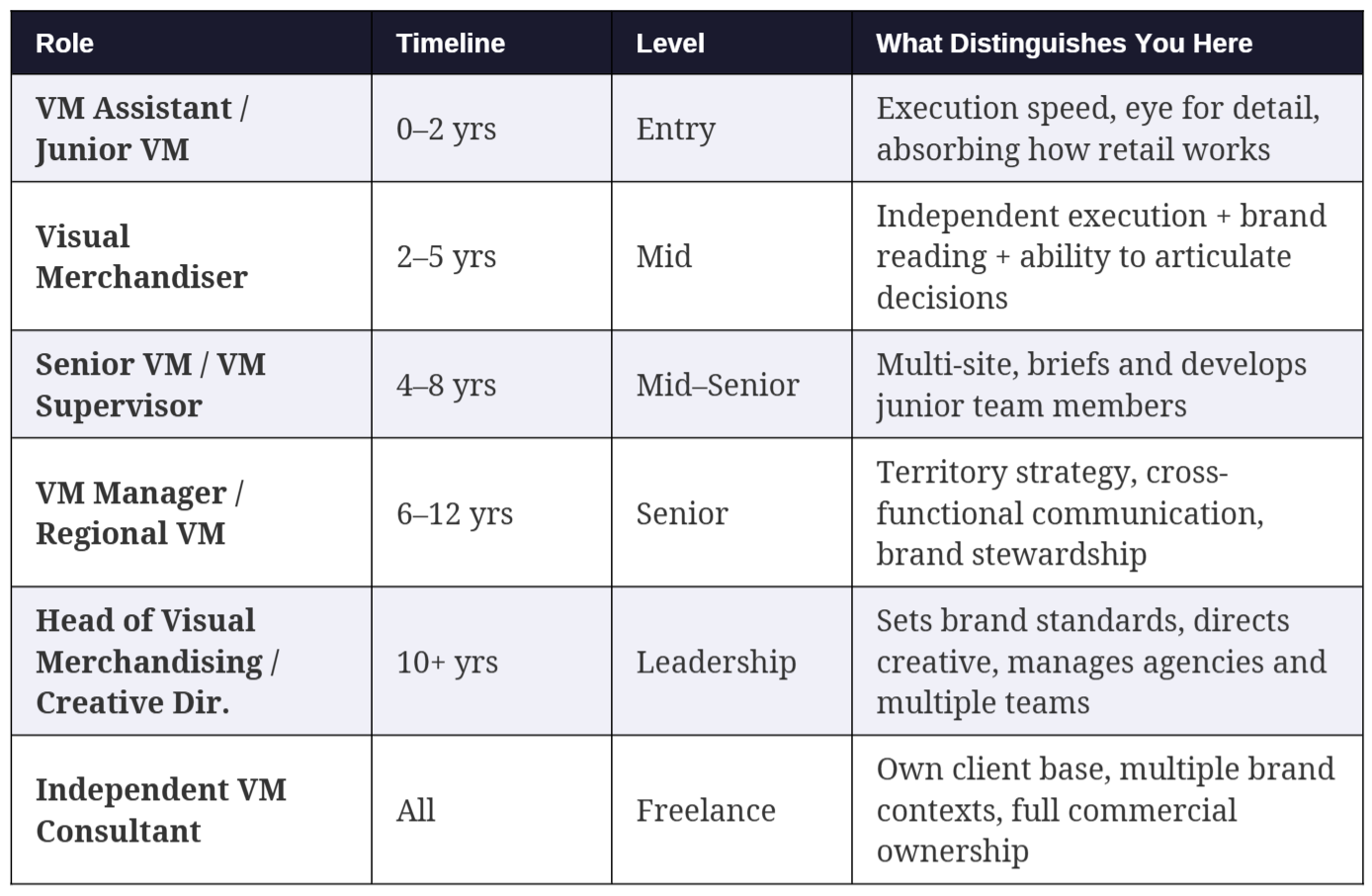
Execution-focused: installing displays, maintaining standards, supporting senior team members. This is where you learn the reality gap between what the instructions say and what the store actually allows. People who move through this level quickly treat it as intelligence-gathering, absorbing how retail works, building execution speed, and beginning to develop an informed point of view.
Visual Merchandiser * Years 2 to 5
More responsibility for a defined area or store. You interpret and implement seasonal direction, make judgement calls, and start developing a recognisable visual voice. The transition to Senior VM often hinges on whether you can articulate your decisions and begin to brief others , not just execute well independently.
Senior VM / VM Supervisor * Years 4 to 8
Multi-store responsibility, or acting as a reference point for regional teams. You're briefing, reviewing, and developing junior team members. Brand consistency across locations becomes a central part of your work. People who plateau here are often those who are exceptional at execution but haven't developed the strategic communication skills to operate confidently at the interface between VM, buying, and marketing.
VM Manager / Regional VM * Years 6 to 12
Full strategic responsibility for VM standards across a territory, product category, or brand segment. You're translating brand directives into actionable guidance, managing team performance, and sitting at the table in cross-functional conversations. This is where the role becomes fully leadership-oriented.
Head of Visual Merchandising / Creative Director * Years 10+
Brand-level authority. You define what the brand looks and feels like in physical space: setting guidelines, directing creative development, managing external agencies and internal teams, and working at the intersection of brand strategy and retail performance. This is a senior leadership role in every sense, usually managing multiple teams across the full scope of the store environment.
Independent VM Consultant * Timeline Is Your Own
The independent trajectory doesn't follow the same ladder: it follows the quality and visibility of your work. The early years are about building proof: strong case studies, word-of-mouth referrals, and a growing ability to handle larger and more complex briefs. Mid-career independent VMs often work with multiple brands simultaneously, across different sectors and scales. The ceiling is defined by the ambition and rigour with which you build the practice, not by a promotion decision made by someone else.
The Real Differentiator: Learning to Think in Space
If there is one quality that separates the professionals who grow consistently in this discipline from those who stagnate — whether in employment or in an independent practice , it's this: the willingness to think about why, not just what.
Any trained eye can identify a bad display. What matters is the diagnostic intelligence underneath: why does the eye get confused here? Why does the product feel cheaper than it is? Why does the space feel crowded when the footfall is moderate? What is the brand communicating in this environment — and is it the right message? And always, support your conclusions with sales numbers. Instinct is the starting point. Data is what turns it into an argument.
That quality of attention rooted in design principles, brand understanding, and genuine curiosity about human behaviour in physical space is what the best VM professionals develop over time. It can be significantly accelerated by practical training.
Make a habit of entering every space you walk into as a practitioner. Not just stores. Restaurants, hotels, galleries, airports, waiting rooms. Ask what the space is trying to make you feel, and whether it's working. This habit, more than any credential, is what builds expertise over time.
If You're Ready to Move - Here's the Next Step
The most common question we receive at Steer Academy is some version of: 'I don't have a VM background, is this programme for me?'
The answer, almost always, is yes, whichever of the three paths you're on.
The STEER Academy courses are built for people repositioning from design, sales, marketing, or another field entirely; for those already working in retail who want to formalise and expand what they've been doing instinctively; and for those who want to build an independent practice and need the methodological foundation to do it with confidence and commercial credibility.
The curriculum covers visual merchandising principles, brand identity and spatial translation, store planning, retail psychology, and portfolio development. built around the real skills the industry looks for. Not certificates for the sake of credentials. Actual capability, applicable from day one.
→ Explore the Courses at steer.academy
This guide was written by Diana Paiva, founder and lead instructor at STEER Academy, and draws on direct experience across Visual Merchandising, recruitment, training, and brand consultancy in the European retail market
